1/29/2019

Osorno, January 2019


For this year's austral summer vacation we went south, to Osorno  and Entre Lagos in the Los Lagos region, for a little relief from Santiago's heat and to see an part of Chile we hadn't previously visited.

Here's the obligatory geography and history lesson:


Osorno, about 1000 km (600 miles) south of Santiago, has a climate like the US Pacific Northwest; mild summers and winters and lots of rain, 1350 mm (53 inches), a year on average.  January is the driest month--we had only sprinkles--and also the warmest with average highs around 21 C (70 F). For us the weather was close to perfect. 


July, the coldest and wettest month, is not perfect.  Rain averages over 200 mm (almost 8 inches), it's winddy and highs average 11 C (51 F). But it seldom freezes.

The city was founded in 1558, at an indigenous village site where Rio Rahue and Rio Damas meet, but was destroyed by the Huilliche, the southern Mapuche, in their victory over the Spanish in 1602.  It was reestablished in 1792, but there wasn't significant population growth until the mid 19th century after the Mapuche were subdued and some 6,000 German immigrant families arrived and regional agricultural development, especially cattle ranching, began.  Cattle are still the major industry; the regional slogan is La Patria de la Leche y Tierra de la Carne (roughly "the land of milk and meat").


Today's city, with a population of about 150,000, serves as the commercial center of an agricultural region of some 230,000. It was bustling with activity while we were there.  The streets were busy with foot and car traffic, stores were full of customers, fruit vendors were on the corners, the central market restaurants were full and so on. Overall a very pleasant city, even if, as one of the guests at our hotel said, "all they talk about is cows."

We arrived from Santiago, on a short hour's flight, and after some confusion (another hotel's courtesy van picked us up and took to the wrong hotel) we arrived at the Santuario Patagonia Hotel Boutique, a lovely home built in the 1940s and now a small hotel. The owing family, descendants of German and Italian immigrants, still live upstairs in the family quarters--when not in Santiago at their other home. 


(click on photos to enlarge)


View from the rear of the hotel.  Our room was upstairs, second from the left.  Below are the living and dining rooms.


Breakfast: Good coffee, local cheese, home made bread and jams, fruit and always kuchen (!).


And lovely bedrooms, unfortunately this one wasn't ours.  Somehow we missed taking a photo.


Behind the house was a large lawn and gardens.


And next door, a parilla restaurant serving the best of local beef. It is owned by the family but operated by one of the best know Chilean chefs, Jorge “Coco” Pacheco.  Unfortunately it was open only in the evenings when eating a big meal was beyond our capacity.


In spite of the rural ambiance of the hotel, it was actually very close to the city center.  The H on the map is the hotel's location and down the road there was a trail and foot bridge (visible on the map) over the river Damas that led to town, 15 minutes away.


And across the bridge, Osorno:


The Plaza de Armas


Loungers in the plaza


 The cathedral


In front of the public market
and fried fish almuerzo inside.
Good (not great), but cheap and filling


Historic immigrant  neighborhood and tourist shops.


We walked all over town and saw the sights, but wanted to see more of the region so on Saturday we took the bus to the coast, an hour or so west, at Bahia Manso. 


We left from the rural bus terminal, a few km west of the plaza.  It was clearly another town center, devoted to supplying the rural population with everything needed, as well as an informal market to sell their produce.  And Saturday was market day.


The road to the coast rises from Osorno, in the central valley at 20 m. to over 300 m (1000 ft).  In the costal mountains the valley grain fields and pastures give way to plantations of eucalyptus and Oregon pine, and drop abruptly to the coast at Bahia Mansa (Gentle Bay).


The area, actually two beach areas ( Maicolpue) and a fishing village Bahia Mansa), is a popular spot for summer homes, and even for Argentinean tourism, as it's the closest beach to Bariloche, 230 km (140 miles), over the Andes at the low Samoré pass. 


We had almuerzo at a pleasant Mapuche restaurant, Kumeyal.  I made my meal from fried seafood empanadas.  They were bigger than I expected.


Near the beach was a statue of Lonko (leader) Anselmo Pallamanque Silva, "tireless defender of his ancestral territory" and an active participant in the recovery of indigenous lands after the return to democracy.


The next morning, Sunday, we went to the other side of Osorno to Chuyaca park for a Mapuche fair, but not much as going on--we were there too early.  The lamb asado was a long way from done and there weren't many people.  So we had a coffee, and went to plan B.


Plan B was another bus ride, this one to Puerto Octay, just off the map above to the south east.  We saw a lot of Los Lagos through bus windows.  It was an inexpensive and comfortable way to travel, with an hour's trip costing  $2-3 US.


We especially saw a lot of cows, mostly mixed Holstein cross herds like this that produce milk and meat.


Puerto Octay is a village settled by German immigrants, now well known for it's cheese.   The buildings below are the cheese shop and general store.


We took a taxi down to the lake to have almuerzo with a lake view, but the restaurant was closed so we had to call the taxi back and eat in the village. Alejandra had the Chilean classic cazuela, a boiled dinner.  I had pasta.  Mistake:  when in rural restaurants order the local favorite.


On Monday our stay in Osorno was over and we took another bus east 50 km (30 miles) to Entre Lagos on lake Puyehue.  On the way we saw Volcán Osorno and Volcán Puntiagudo (sharp pointed) and took these shots from the bus window.


After finding that the reservation I had made turned out to be a bust, we canceled it and went walking to find something better. We did: The Hotel and Restaurant Entre Lagos. Clean, comfortable, economical with views of the lake.


Dining room where we had breakfast every day--with kuchen.


A down stairs lounge, near our room.


The view from the terrace.


We spent a lot of time walking around town.  It was very pleasant, the weather was perfect and the flowers (see below) were beautiful, but there wasn't too much else to do.


We had coffee here, in the village center, and walked along the lake.


It was a relaxing stay.  We had two good meals at the restaurant, salmon from the lake and steak, and a couple more, here and there, that were not memorable.
One evening the town hosted the Chilean national cueca championship with teams from all over.  


In the afternoons while I napped and had a whisky, Alejandra went walking to the nearby bakery.  We first stopped in because it was named the Paslelerá Celeste. Celeste is Alejandra´s oldest grand daughter.


On later visit she made friends with the owner and learned all about the local ¨news¨ and social life. There was a lot to hear since she was born and lived most of her life in the village and, of course, knew everybody.

And on one visit Alejandra helped make bonbons.


 At the east end of the lake is an area of hot springs, called appropriately, Aguas Calientes,  and the Puyehue National park.


The park headquarters included a very good small educational display of the flora and fauna, and across the Río Chaleufu there was a very well done nature trail.


But there were Tabános!

These large horse flies come out in swarms in January in this part of Chile and they bite.  Fortunately they are slow and can be swatted if they land on you, but some prefer to try to wave them away.


Fortunately too, they like to be in the sun.  Once in the forest they disappear, so it was a very pleasant walk after all.


Afterwards Alejandra went for a dip in the hot springs pool, then we swatted flies and waited for the bus back to Entre Lagos. 


.

Overall, a very nice vacation.  No problems, no drama.  We especially enjoyed two products of the climate and volcanic soils: the cheese and the flowers. Below is a round of 2 kg we bought (very inexpensively) from one of the hotel maids.  Her sister made it.


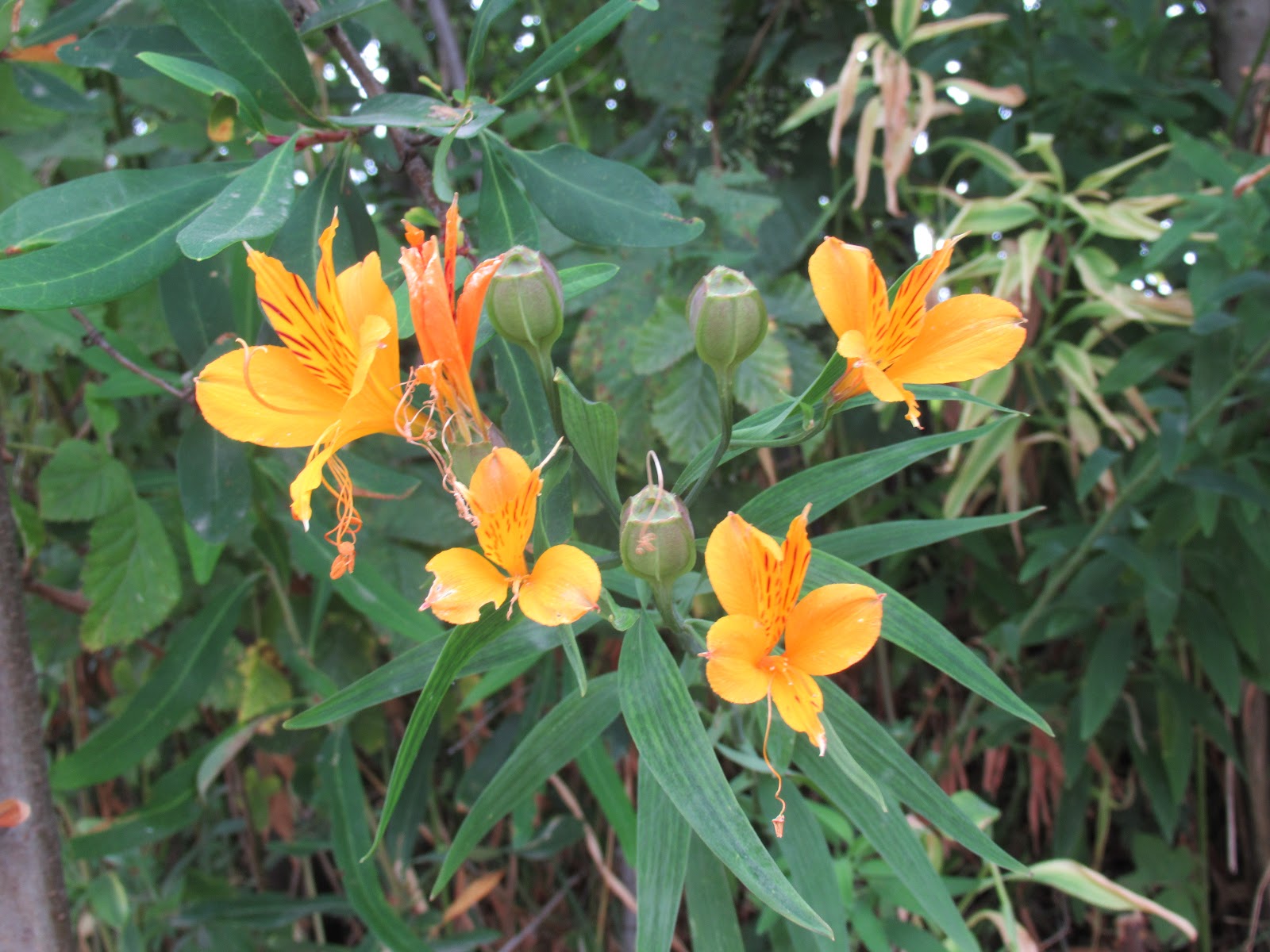
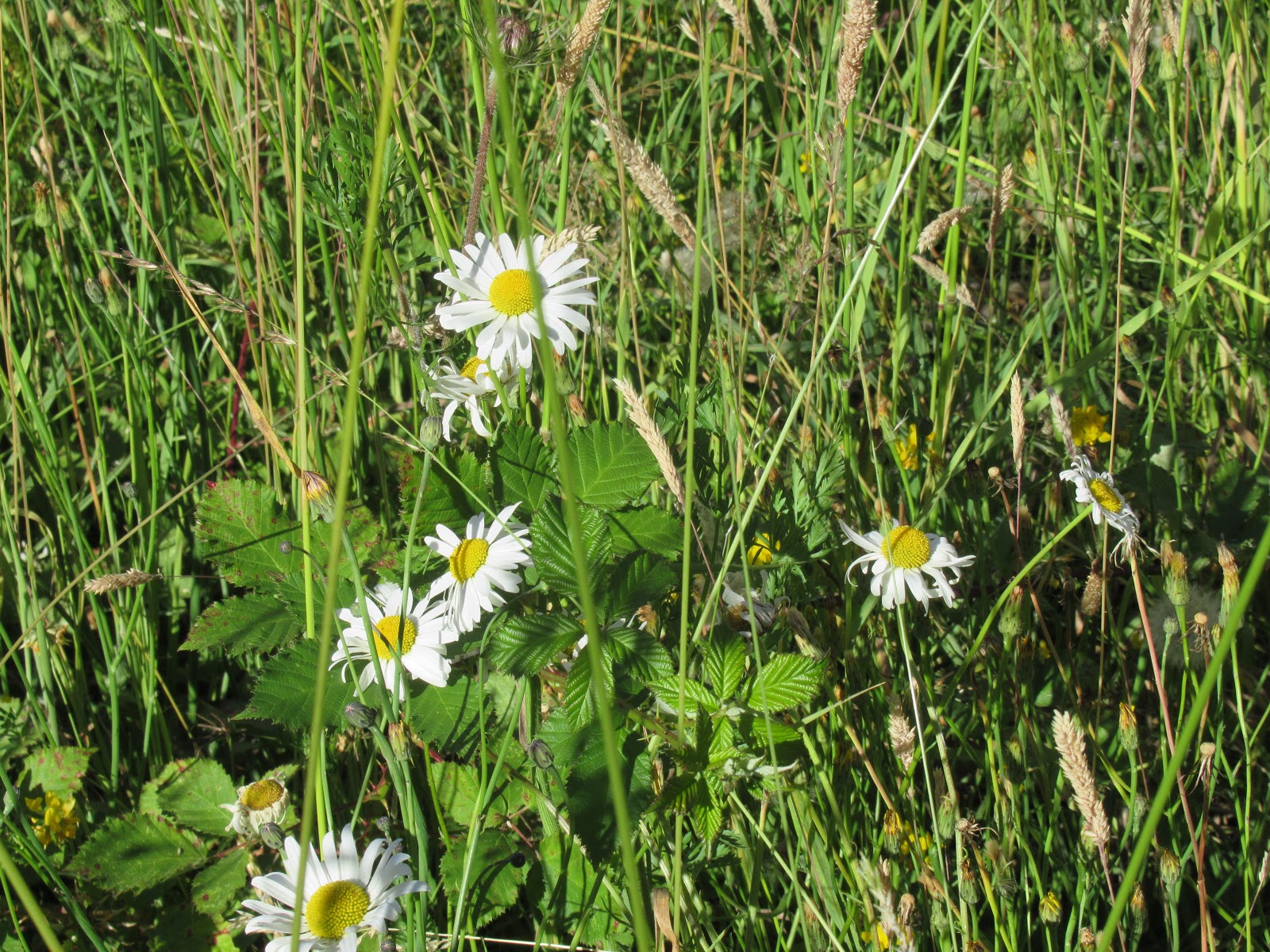
And below that, the flowers. Alejandra loved the exuberance and variety of the flowers and took lots of photos.  Click on the photo to enlarge.


1/28/2018

Arica

Our 2018 southern summer vacation was in Arica, in far northern Chile near the Peruvian and Bolivian borders. Things didn't start out well; on arrival I left my debit card in an ATM machine at the airport and lost it and the next day Alejandra had a bad reaction to a fish dinner and had to go to the emergency room where she spent the night an all of the next day, Saturday.  Sunday we stayed in the hotel and rested, but by Monday she had recovered and we went back into vacation mode. (Click on photos to enlarge.)

So we went into town.  Arica is a coastal city of about 200 thousand in the Atacama Desert where two valleys, the Azapa and the Lluta, bring water down from the Andes. These valleys were home to a series of indigenous cultures from about 10,000 years ago and Arica was settled by the Spanish in 1541.  It was part of Peru from independence until Chile defeated Peru and Bolivia in the War of the Pacific and occupied the coast all the way to Lima. The current border border with Peru, 18 Km north of Arica, was agreed to in 1883.

Downtown lies under the morro de Arica, site of the battle in which the Chileans defeated the Peruvian garrison, and which now has a huge Chilean flag and a large statue of Christ.  


(Click on photos to enlarge.)

The commercial center includes a pedestrian mall--fairly pedestrian in itself--with the usual assortment of cafes and stores and, due to the nearness of Peru and Bolivia, currency exchanges. 


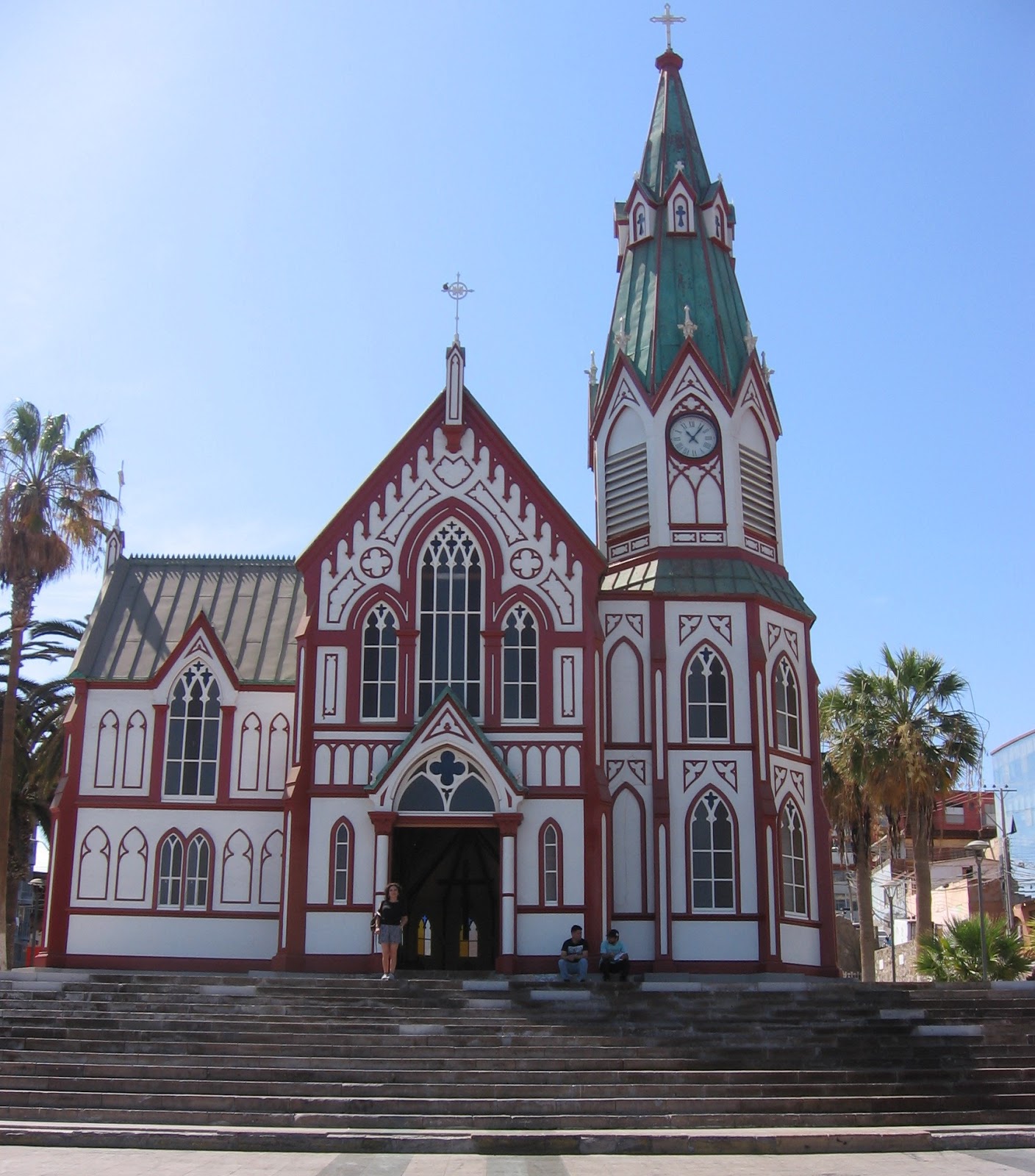
Nearby is the Cathedral de San Marcos, rebuilt in 1876 after its 226 year old predecessor was destroyed, along with the rest of Arica, in the earthquake of 1868. The building is all metal, prefabricated in France and shipped around the horn.


After leaving the mall and the old city center we went to the fisherman's wharf, complete with the usual assortment of small fishing boats, seals and pelicans.


 And we took a harbor cruse.


The major activity of the port is shipping cargo and oil to landlocked Bolivia, which lost its access to the sea following the War of the Pacific.


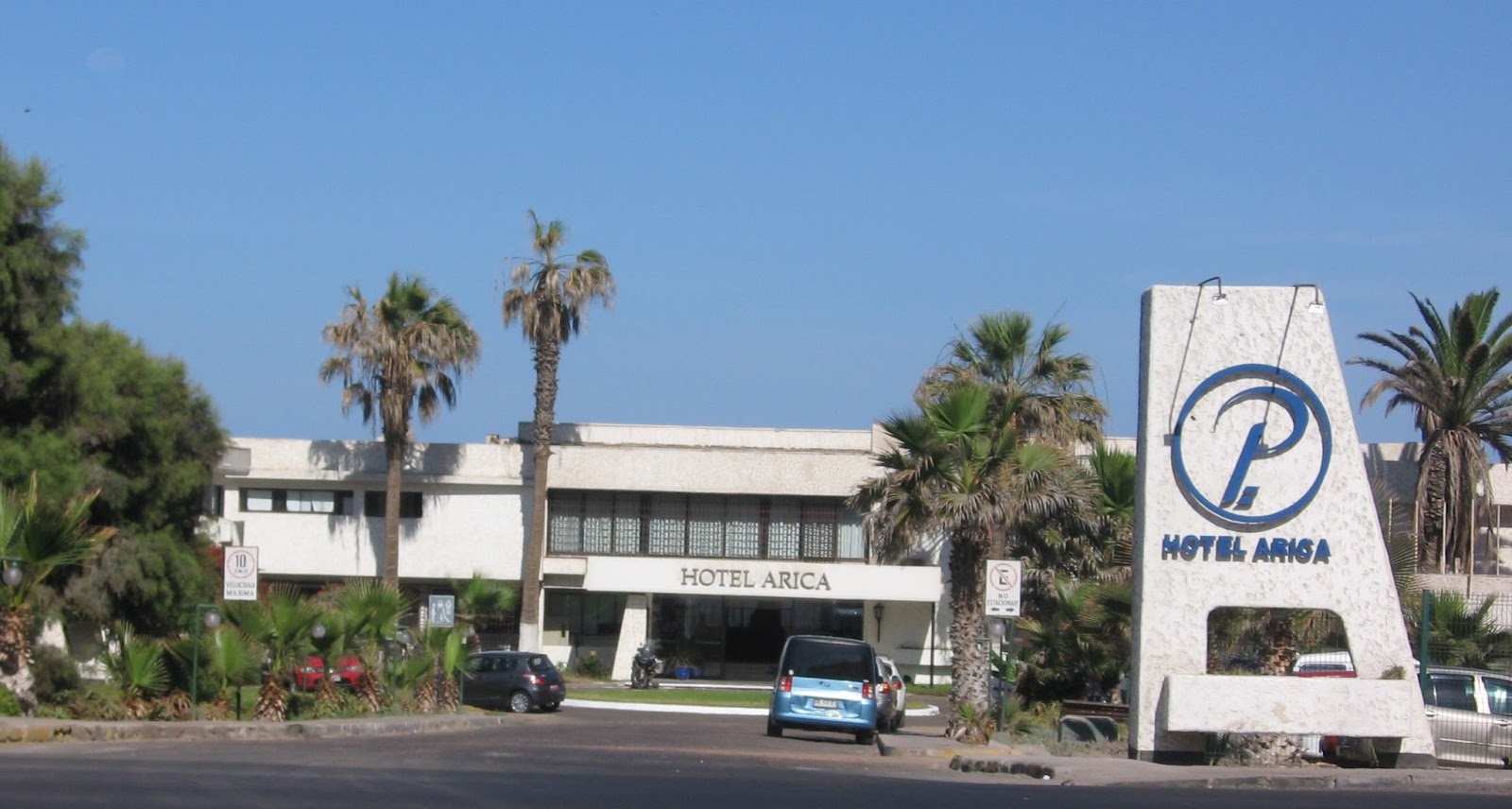
Then back to the Hotel Arica.  Build in the 60s and showing its age, it's pretty clearly the best Arica has to offer, and is clean, comfortable, attractive, on the beach and has good food. All the essentials. 


Pool


Salt water pool


Terrance 


Dining room


Bar


Ocean View


And good food, nicely presented.  There was a daily menu of salad (left), main dish (usually fish), dessert, wine or soft drinks and coffee at 10,000 Chilean pesos, about $16 US, and a very good breakfast buffet, included with the room. After Alejandra's unfortunate episode with fish, she ate mostly off the a la carte menu but they were quite accommodating about making adjustments.


In the evening we took a walk south along the coastal highway to La Lisera beach, popular for family pick-nicks and, since it's lighted, evening activities. 


Tuesday was Azapa and Lluta valley tour day, a round trip of some 70 Km. 


The lower valley is the Azapa, were the intermittent Rio San Jose is fed by rain and melting snow in the Andes. The upper valley is the Lluta, where the river flows year round, heaviest in January and February.  In between the road runs from San Miguel Azpa up about 1000 meters and then down into the Lluta at Poconchile. (The black line to the north is the Peruvian border.)

 Our first stop was at Arica's Terminal Agropecuario, a huge market selling produce from the valleys--especially tomatoes and olives--as well as products from Peru and central Chile.  The characters are (L to R) the Swiss tourist Rafael, our guide Ernest, Rafael's Brazilian wife Glindis, and Alejandra.


Our next stop was a hill over looking the valley and the geoglyphs on the adjacent hill side. The flat expanse of cloth covers tomato fields, protecting them from the strong sun. The green bands in the distance are olive groves. Arica and the Pacific are in the distance.


These geogliphs, formed by positioning darker colored rocks on the sandy hillside, among hundreds in the Azapa and Lluta valleys, fate from between 500 and 1000 AD.  Similar features are found throughout the Atacama desert and north to the famous Nasca lines in Peru.  We also saw geogliphs near Iquique, were we went in summer 2010. 


Next stop was a very pleasant estancia with olive groves and many other fruits.  The photo is of the sales room, where Azapa olives, olive wood carvings and T-shirts were available. The olives are cured using only salt brine.  See the worthwhile article "Chile celebrates olives from Azapa" which includes a good video (in Spanish). For more on Chilean olives I happen to know of a pretty good blog: "Chilean olives and olive oil."


Azapa ripe olives.  The purple color is the natural color after salt brine curing. Black ripe olives are cured with lye in hours, rather than weeks.


Next stop:  University of Tarapaca's Museum San Miguel de Azapa 


The museum's main collection is of the Chinchorro culture (9000-3500 BP) including their mummies, dozens of which have been found locally. They were a fishing, and after 4000 BP, horticultural culture.


The museum also has the olive press from the original estancia at that location. The crushed olives were placed in baskets beneath the huge beam which pressed down on them with its own weight and the pressure of a large wooden screw pressing down on the far end.    


Crossing the ridge, La Quebrada del Diablo, between the two valleys was scenic, if not verdant.  


But the Lluta valley was both.  The Rio Lluta runs year round, but the water's high mineral content limits agriculture to a few crops: mostly alfalfa, onions, potatoes, and an indigenous salt tolerant corn.  


After crossing we stopped in Poconchile at the 17th century Church of San Jeronimo.    The twin belfries were added later.


Poconchile has only around 120 inhabitants, somewhat fewer than the residents in its cemetery. But it was a much more important community in the past. The church was the site of the first Arica parish, built to Christianize the local Indians, was and still is on the road from Arica to the Altiplano and Bolivia, and was was a stop on the Arica-La Paz Bolivia railway from 1913 until 2005.


And there are several restaurants--pretty basic (salad, meat, rice, potatoes)--but not bad.  We ate here at Puro Chile.


Our last stop was at the mouth of the Lluta, a protected area where up to 20,000 birds of 125 species congregate in December through February, many from North America.


The most common, seen all over the Arica waterfront, is the Franklin Gull.  


There are crabs too.


The following day we took another tour, the "panoramico."   


We arrived a little early.


The first stop was the mouth of the Lluta, which we saw the day before, but we had more time and our guide, Jennifer, was much more knowledgeable about the birds. 

Then we went to the Cuevas de Anzota, where the government is building a coastal pathway to the caves.


In addition to having been a shelter for the Chinchoro people, the caves and the surrounding cliffs were originally covered with a thick deposit of guano from sea birds which was mined for fertilizer. 


Our final stop was the Morro, overlooking Arica.


The city


 And on the point below, past the cove, our hotel.


On our final day, we took a tour to Tacna, the Peruvian city about 35 km from the Chile-Peru border and 45 Km from Arica.  


Tacna, a city of about 300.000, is a commercial city, like Arica, but without beaches.  Which is to say, it has little to offer tourists.  Our tour, we discovered, was a "shopping tour," which is what most people go to Tacna for.  Peruvian prices from gasoline to laundry detergent, toilet paper and restaurant meals are less expensive that Chile's.  


First stop was the main plaza, where we had our picture taken in front of the cathedral, started in 1875, delayed by the war, and finished in 1954.  


Then to a mall, where we bought Soles (Peruvian currency) and had a great liquado, AKA smoothy. Our companions are the Swiss-Brazilian couple and guide from the earlier tour and a Chilean couple.


More shopping followed; the Chileans knew why they were in Tacna--they bought lots. And then we went to almuerzo at a very good restaurant, "El Mar Adentro." 


I had a very good dish, filet of dorado, which in this case seems to have been a tropical catfish, crusted with black pepper corns, basil oil and a risotto of rice with yellow chile. Following her earlier experience with a different fish (also called dorado) Alejandra had to pass on fish, but had grilled chicken with a quinoa risotto.


Then following another shopping adventure (we bought souvenir T-shirts as gifts) we went back to Arica, and then back to Santiago the following AM.