Showing posts with label Argentina. Show all posts

3/18/2017

Ushuaia, End of the Earth


(Click on pictures to expand)

Ushuaia calls itself “The City at the End of the Earth.” And it is. It’s 1500 miles south of Buenos Aires and about 700 miles from northern Antarctica.


We had previously been to Chile’s southernmost city, Punta Arenas (which I wrote about here), and that trip inspired us to risk going further south. I say “risk” because Ushuaia is notorious for storms, sometimes so strong that ropes are stretched along sidewalks to hold on to. We would be going in midsummer, early February, but even then daily highs average 55° F. and rain is expected on about half the days. But Santiago was having the hottest summer ever, including a record high of 100°, so cooler weather sounded good. 


We flew out on Feb. 6; 1 ½ hours to Buenos Aires and another 3 ½ to Ushuaia, dropped through the low cloud cover and rain into the modern airport. A 15 minute taxi ride took us to the Patagoina Villa, where we had reservations for 6 nights.  The Villa includes a large lodge and several cabins.  Our cabin, right, had a fully equipped kitchen and bath down stairs and a bedroom above.


Breakfast was self-serve with breads, cereal, milk, yogurt, coffee and coffee maker and spreads restocked each evening.  A well-stocked refrigerator, wine rack and snack basket with prices not much above local stores offered other temptations.

We enjoyed our time there and especially appreciated the friendly service and good advice on what to see from owner Luciana, her son Gino and manager, Manuel.

We got up the next morning, pleasantly surprised to see blue sky, dotted with white (not grey) clouds, and walked into town; about 15 minutes—downhill.  


Ushuaia, capital of the Provincia de Tierra del Fuego, Antártida e Islas del Atlántico Sur, is a new city.  The area’s first European inhabitants were English missionaries who arrived in 1869 to Christianize the indigenous Yaghan population.  In 1873 the appropriately named Argentine President, Julio Argentino Roca, recommended that a prison be established there, and in 1896 it was.  The prisoners’ labor built the town, the railroad that delivered construction materials, and the prison which operated until 1947.  At that time the town had about 2200 residents. Today’s population is about 60,000, supported largely by electronics assembly, gas and oil extraction and tourists.

We only saw the tourism, but plenty of that. Our first day’s activity was a walk along main tourist street, Avenida San Martín and a return one block down along the street bordering the coast. San Martín is filled with the usual souvenir shops, restaurants, upscale clothing shops, tour agencies, etc.; worth a walk through but relatively uninteresting unless your stack of penguin t-shirts is running low—which of course, with 5 grandchildren between us, ours was.


Returning via the coastal street was more interesting.  We passed the Plaza Isla Malvinas honoring the Argentine heroes of the Falklands Islands war.


The text says “The people of Ushuaia to those who… watered the roots of our sovereignty with their blood.  We shall return!!!”  This 1982 war, which Jorge Luis Borges likened to “two bald men fighting over a comb,” took 749 Argentinean and 255 British lives.  


The walk along the Beagle Channel water front provides a nice view:


...of the cruise ships.  These were (left to right) Quark Ocean Endavor  (200 passengers) the Sea Princess (2400), the Fram (318), and the Hanseatic (127).  According to the port schedule 14 cruise ships arrived while we were there.  Over 100,000 tourists visit each year, mostly from cruse ships.


…their passengers waiting for bus tours


...and the tour boats.


 …and of the city and Glaciar Martial where we went the next day.


The next morning was clear and cool again, so we took a taxi to the start of the ski run/trail leading up to the glacier. One of us found the going a little slow, but the view was great.


And even better at the top… or almost at the top.  It was another strenuous 45 minutes’ walk to the glacier at 1,050 meters (3,445 feet).  We declined.


Fortunately there was a refugio at the bottom.  Does someone look tired?


Almuerzo, was next.  Ushuaia is known for its merluza negra (Chilean sea bass, aka Patagonian tooth fish), centolla (king crab) and lamb, and this was my day for lamb.


Unfortunately, food is expensive in Ushuaia, at least by South American prices.  Our lunch for two was $50 US with an order of lamb (delicious), a grilled chicken breast, salad, French fries, bottled water, a half bottle of wine; + tip (10%) extra. If you order Chilean Sea Bass or King Crab you can expect up to double that, or you can spend a little less, $30 to $40 for pasta, local trout, milanesas (breaded cutlets), etc.  Pizza, empanadas, burgers will be less, though expensive.  


After almuerzo we visited the Museo del fin del Mundo, an interesting if unremarkable museum with a good display of the fauna of Tierra del Fuego (photo Wikipedia) and a little video room with films of explorers and indigenous Fueguinos.  Good place to spend some time sitting instead of walking.


The next day we went to the National Park, west of Ushuaia a few miles and stretching to the Chilean border.


The tour began by taking us to the fin del mundo train station where we waited with an international crowd from the cruise ships: Japanese, Australians, Brazilians, French, Americans, Chileans, Germans and even a few Argentinians. 


Then it was on to the trains.  


The tracks follow the Pico River up the valley for 7 km


Stopping about half way for photos. 


The 1931 photo shows prisoners with the one of the original steam locomotives.  The train ran until 1952 and was reconstituted as a tourist attraction with rebuilt tracks and new steam locomotives in 1994.


 From the train’s end point in the we took a tour through the national forest ending at the Bahia Lapataia on the Beagle Channel at about the same time as a tour boat and a dozen or so tour buses.


This was truly the end of the road; in this case the Pan American Highway.


The following day we went to the prison. 

 With 5 two-storey wings and space for 540 prisoners, there is plenty of room for museum exhibits.  In addition to the actual museum and its inmates, there is information on prisons from around the world, a maritime museum, an Antarctic exploration museum, an art museum and an art gallery.


And of course, there are biographies of the famous prisoners; here (the thin one) is Cayetano Santos Godino, captured at 16, a serial killer who tortured and killed other children. He died in prison at 44. 


Saturday, our last day in Ushuaia, we went for a boat ride, east on the Beagle Channel, named after the HMS Beagle on its voyage of 1826-1830; the trip prior to Charles Darwin’s voyage on the Beagle.

(click on map for better view)

Our trip took us out into the channel, past locally designated:

 "Bird Island,"
(imperial Cormorants in this case)


 "Sea lion Island" 


and "Penguin Island."  (Humboldt Penguins)


We also passed Puerto Williams, "the town at the end of the earth."  It is on Chile's Naravino Island, and is further south that Ushuaia, but with a population of less that 3000 civilian and Chilean naval personnel it doesn't qualify as a city.  


Our destination at the end of the boat ride was Estancia Harberton, established in 1886 by Thomas Bridges, an Anglican missionary and author of a Yagan-English dictionary of 30,000 words.  After retiring from the mission, the Argentine government gave him a land grant and he turned the mission into a working estancia or ranch.  It is now owned by his grandson and run as a tourist destination.


Off our tour boat we had lunch and a tour of the estancia and visited the adjacent Museo Acatushun, a working scientific museum with a collection of 28,000 marine mammals and 23,000 birds.


Our return to Ushuaia was by bus, on a gravel road via the valley of the Rio Larsiparsabk.


Our day was calm and bright but the few trees showed that the weather was not always so calm.


We passed several areas of dead trees in beaver dam flooded valleys. Beavers were introduced to Tierra del Fuego in 1946 to establish a fur industry.  Unfortunately, the fur industry was not successful, but with no predators, the beavers were.  Today an estimated 200,000 beavers damage thousands of acres of forest. 
Leaving the valley we reached Argentine highway 3 and crossed the mountains to return to Ushuaia.  And it began to rain. 


7/03/2011

Visiting the “Southern Cone” – Argentina and Chile

Friends,

Since you are thinking about coming for a visit, here is the long promised visitor’s guide.  I’m assuming you have a guide book of some sort (I like Moon guides and they have one for Patagonia that also covers Santiago and Buenos Aires) so I’ll concentrate on my experiences.

The obvious points for arrival are Santiago and Buenos Aires. 

I spent about a week in Buenos Aires in November, 2006.  I was traveling alone (on the way to meeting Alejandra) so my sight seeing involved a lot of walking and not much night life.  I stayed in San Telmo, the oldest BA neighborhood and to my mind the most interesting:  lots of antique shops, a semi-permanent (but best on Sunday) flea market of antiques and junk, Tango shows and lessons, restaurants, parks and museums.  I also enjoyed La Boca, the old port neighborhood and red light district; now very touristy; the Japanese gardens; up scale Palermo; the street markets with asados (BBQ); etc.   It’s an interesting city.

A La Boca restaurant


 The Japanese Gardens


A Sunday street market…


and the accompanying asado.


Montevideo is just across the Rio Plata from BA, 3 to 4 hours, by combination of boat and bus. The old city is very pleasant (if a bit shabby) with lots of street side cafes and vendors, good food, and small enough to get around easily.  And it’s on the coast with a miles long walkway along the bay side.


From Montevideo or Buenos Aires to Santiago is about 2 hours by plane with a dozens or so flights per day, and there is also bus service (12-14 hours) on luxury buses for a fraction of the airfare. In 2006 I went by bus from Montevideo to Mendoza, Argentina (just over the Andes from Santiago) because I wanted to see some of the country.  Unfortunately I could only find over night trips, but we left mid afternoon so I saw a bit of the area.  You may be able to arrange to go by day to somewhere in between, spend the night and leave again next AM.


Santiago is the other obvious arrival point.  It’s a modern city with no “old city” or especially picturesque neighborhoods, but there’s enough to see to keep you busy for a few days and a week by our pool in mid vacation would be a good way to avoid over doing it on a long trip.   Providencia is the modern down town neighborhood and business center, Bellavista, our “bohemian” community, is full of restaurants, shops and night clubs; the nearby Patronato is Santiago’s Korean and Arab garment district; the Mercado Central is a seafood market and restaurant center; across the river is La Vega, Santiago’s labyrinthine public market; and the Pueblo de los Dominicos, is an artisans’ village with some of the best of Chile’s crafts for sale. There are several wineries in Santiago that you can visit and 60 miles south is Santa Cruz, the center of Chile’s wine country with a wine train, vineyard visits, an interesting museum, hotels and restaurants.  There is also the Mapuyampay Hostal Gastronomico a lovely (and expensive) hostel with cooking classes and excellent food.  Just south of the city is the Cajon de Maypo which takes you up into the Andes, and 30 miles to the west is pottery making village of Pomaire, and of course Valparaiso (funky and picturesque) and Viña del Mar (upscale beaches, shops and restaurants) are an hour away on the coast.  

The pool


Valpariso


Viña del Mar


Mendoza, Argentina’s premier wine area, is just over the Andes from Santiago, 6 or 7 hours (sometimes more depending on how crowded the customs port is) by bus or van, and of course an hour or so by air.   The road trip, which goes up to over 11,000 feet is worth while for the view.  I saw condors at the top.


Mendoza is a very pleasant city of 120,000 or so and you can walk from one end to the other in an hour or so.  The town center has a pedestrian mall, and there is a large park to the east of down town.  There are lots of hostels and hotels of all classes, wine tours are widely available, and there are lots of good restaurants to complement the wine.


The border crossing


Mendoza town center


Although the cities are interesting The Lakes Region, on both sides of the Chile-Argentina border, is what I think makes a visit worth while. The scenery is magnificent, there’s lots to do,  and the German and Swiss immigration (continuing today) and architecture give the area a very European feel.   
Click on map to enlarge
The place to start is Villarrica, about 500 miles south of Santiago – 10 or 12 hours by bus (there are also flights in summer).  I spent about 10 days in and around Villarrica and the nearby Huerquehue National Park in 2005 when I first came to Chile and wrote about it here.  It is at the west end of the Lago Villarrica (upper left quadrant of the map below) and Pucón (not on map) is at the east end of the lake, below the volcano. Both are full of hostels, hotels, restaurants, craft shops, and have beaches for swimming, boat rides, etc. plus tours and guides for climbing the volcano.  Villarrica is the larger of the two, while Pucón is the more popular tourist destination.  Alejandra’s brother German has a time-share apartment there and we have visited several times.  I prefer Villarrica; it’s a bit less hectic during the January-February tourist season, and Pucón is only a 30 minute bus ride away.

Pucón street


View from German’s Pucón apartment in  in February

Rural buses (or you can rent a car) go from Villarrica to the surrounding villages, lakes and hot springs.  The area is also a center of Mapuche (Chile’s indigenous people) culture and crafts and there are ethno tourism opportunities.


Lake Coñaripe, south of Villarrica.


The Argentinean Lakes region is just across the border, and a bus takes you from Pucón to San Martin de los Andes, 150 miles over the Andes through Araucaria forests.  Crossing the border is quick and simple (you may not even have to get off the bus). 


The border crossing between Pucón and San Martin de los Andes

San Martin is a lovely little city with all the usual Lake District activities:  hiking, swimming, boating, trout fishing, tours, and skiing in winter.  It is also less crowded, less expensive, and more accessible than Bariloche, Argentina’s prime tourist city, 125 miles south.


San Martin's main street


A San Martin Hotel

There are two ways to get from San Martin and Bariloche:  the normal bus route and by van via the seven lakes road.  By all means take the seven lakes route.  Here are a few photos:


Blurry lupines from the van window


One of the lakes


Baroiloche from across the lake.

Bariloche is Argentina’s Aspen, drawing skiers and tourists from around the world, winter and summer.  It has something for everyone, from 5 star hotels and elegant designer shops to $15 a night hostels and Chinese-made alpine-themed souvenirs, plus dozens of shops selling, chocolate, ski apparel, wine, children’s clothing, etc., etc.   I spent a week there in 2005, mostly in bed recovering from a cold, and was grateful to be across the street from a well stocked international delicatessen from which I fed my cold on French cheese, Spanish sausages and Argentinean wine.  And Alejandra and I visited for a few days in ’07.  I’m glad I went, but would not choose Bariloche as the headquarters for another vacation; we prefer places that are a little less glitzy, like San Martin.)


The obligatory Bariloche rent-a-dog photo.


And a tango show.


But it’s worth going to Bariloche if only to leave again via an all day or two day boat and bus journey to Puerto Montt in Chile.  The boat leaves Bariloche and travels the end of Lake Nahuel Huapi, then by bus across the border to Lago Fria, another bus to lake and Todos los Santos, and then on to Puerto Varas and Puerto Montt.  It’s expensive, but the views are spectacular. You can also go by bus only for a fraction of the cost.  


Crossing Lake Nahuel Huapi


Arriving in Puerto Blest


Mount Tronador 


Volcan Osorno

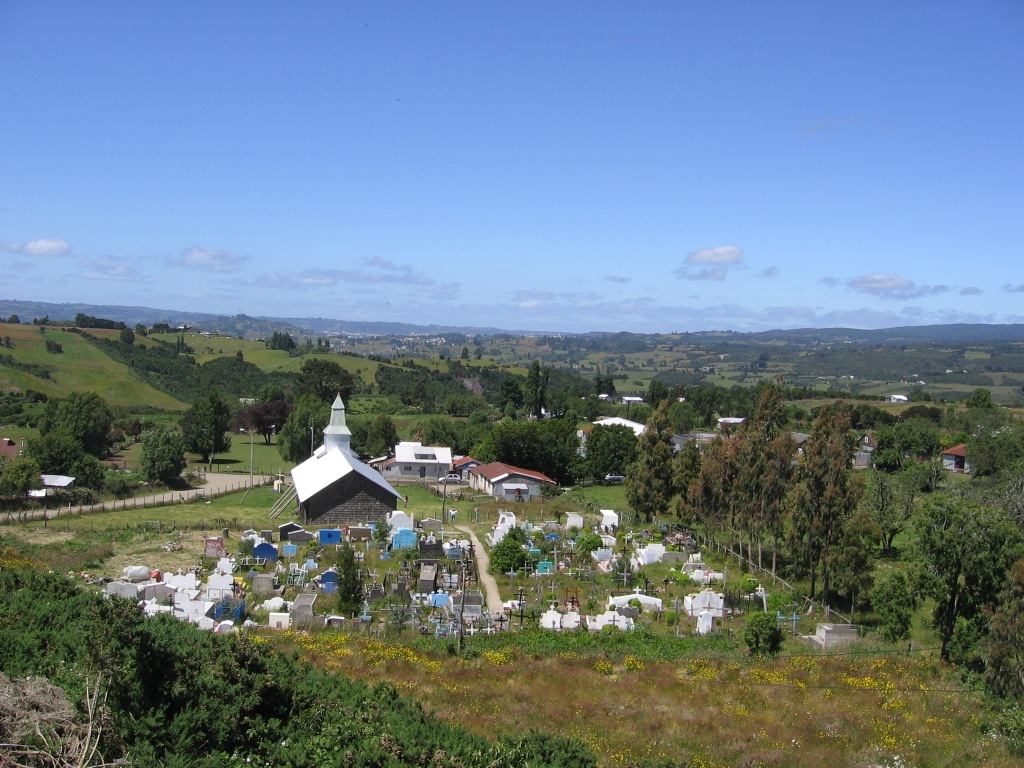
Puerto Montt, the end point of the trip,  is the southern terminus of the Pan American Highway.  The city is moderately interesting, but probably not worth more than an over night stay.  But it is the gateway to Chiloé which is worth a visit.  The Island was settled by the Spanish in the 1560s, but was isolated from the rest of Chile by the Mapuche-controlled mainland until the 1880s.  In isolation it developed a distinctive mestizo culture based on native potatoes, fish and shellfish—all of which are still available in great abundance. It's wooden churches are a UNESCO World Heritage site.Tourism and salmon farming are now the main industries, but it is still very low key and among the most interesting parts of Chile. I spent a week or so there in 2005 (see part 3 of my trip journal) and that is where Alejandra and I met.  Naturally I've written about the food.


Dalcahue village, Chiloé


Palafitos, houses on pilings in Castro, Chiloe’s largest city


Interior of Castro's wooden church


Chiloé fishing boats

To go south from Puerto Montt you must fly or travel by boat.  On my first visit to Chile in 2005, I took the Navimag car and passenger ferry south to Puerto Natal, an incredible trip.  It’s in my journal.

At the other end, Puerto Natales is the access point for Tores del Piane National Park


The easiest way to see the park is to take a one-day bus tour from Puerto Natales, but there are now hotels and hostels in the park that can serve as a terminus for the 5 day trek around the peaks.  Backpacking equipment is available for rent in Puerto Natales. 

From Puerto Natales the road south leads to Punta Arenas on the straights of Magellan and across by ferry to Tierra del Fuego and the Argentinean city of Ushuaia.  I only made it to Punta Arenas.  Interesting city, but not essential.

But north in Argentina, a day by bus, is El Califate and the Perito Moreno Glacier.


And from there you fly out to Buenos Aires or Santiago.


------------------

Ok… you can do it all in a couple of months!  Fly to Buenos Aires for a few days and then to Mendoza.  Bus from Mendoza to Santiago.  R&R in Santiago by the pool with a side trip to Valparaiso. Bus to Villarrica/Pucon, then to Bariloche via San Martin de los Andes.  Bus and boat to Puerto Montt, and then tour Chiloé via rental car.  Back to Puerto Montt and boat to Puerto Natales.  Visit Torres del Paine and on to El Califate.  

When to Come

December through March should be fine for most locations, though January and February are best for Chiloe and the south.  And of course the austral winter is not bad in Santiago with skiing nearby and in the Lake District.

Hotels

We generally stay in hostels or B&Bs in the $50 to $60 a night range or hotels in the same price category.  They tend to be clean and comfortable, with small rooms and simple breakfasts.  International tourist hotels of 3 stars and up should run from around $80 to as much as you would care to pay, but will have English speaking staff, internet connections, cable TV and a breakfast buffet. At the other end, backpacker hostels are $15 a night per person an up, with shared bath, simple breakfast, and interesting company:  backpackers in their 20s from all over the world plus a few older travelers.  I frequented backpacker hostels on my 2005 trip and highly recommend it.  It was great for a person traveling alone or if you want to meet fellow travelers.  And the owners--often German-Swiss immigrants, usually speak English.  Note that in Chile foreigners are exempt from the 19% IVA on hotel rooms, though this usually only applies to hotels and not hostels.  Ask. 

Food

In both Argentina and Chile breakfast is usually light and provided by your hotel or hostel.  Instant coffee, bread, jam, and a bit of cheese and ham are common in Chile.  In Argentina you will usually get coffee, croissants, butter and jam.  Almuerzo is the main meal of the day, eaten between about 1:30 and 3:00, and many city restaurants offer a menu executiva of first and main course, dessert, a drink.  There is usually a choice of 2 first and 2 main courses, and beer, soft drink, wine or coffee.  In Chile they cost from $8 to $12 US, a bit less in Argentina.  If you order off the menu (la lista) side dishes (agregado) of potatoes, rice, etc. may be included or separate. Ask.  A nice meal for two with wine in Chile usually costs $35 to $65, averaging around $45; $80 or more is considered expensive.  Seafood is usually your best choice and unless you want it fried, ask for a la plancha, grilled.  And of course more than you ever wanted to know about Chilean food is in Eating Chilean, and there is also a brief "Visitors Guide: What to Eat in Chile.".  Table wines will run $10 to $20 a bottle. In Chile varietals are standard table wines, with lots of fruit and not much wood.  Reservas tend to be more expensive and are usually aged in wood.  I generally order varietals.

In Argentina the main focus is on beef and Italian food.  The classic parrillada is a mixed grill of beef steaks, innards and sausages and befe de chorizo is the most Argentine steak on the menu. Jugoso is rare, a punto is medium/medium rare.  I found most Argentinean restaurant wines too “soft” for my taste, which is evidently what locals prefer.  Tell the waiter that you prefer wines with “buen taninos” and you may do better. And although Argentina has faced high inflation, it is still a bargain by US standards, with “long tablecloth” restaurant meals for two at $30 to $50 US. 

Cena is “supper,” usually eaten 9:00 to 11:00 in restaurants where the menu will be the same as that for almuerzo.  I suppose some people eat both almerzo and cena every day, but we usually have almuerzo and then a sandwich or something light around 7:00. 

If you adapt to South American meal times you will eat very well, but if you arrive at a restaurant at noon expecting “lunch,” or at 7:00 expecting dinner, life will be difficult.  Restaurants will be empty and they will ask you what you are there for.

Money

ATM machines (cajeros automaticos) are available almost anywhere you go as a tourist, and in Chile they charge a $5 fee for withdrawals.  Credit and debit cards (Visa, Master Card) are also accepted most everywhere, but you will pay a 3% foreign exchange fee to your credit card company.  (Incidentally I use my credit union debit card in restaurants, stores, etc., as there is no foreign exchange fee.)  US dollars are good for emergency cash, but not for every day expenses in either country.  Get pesos at the airport ATM.

Transportation

Travel by bus if you have the time.  Service and comfort are excellent and it is inexpensive.  Flights are expensive, though if you buy local flights using the national--not international--web site (Lan Chile) you may get a better deal.  Car rental is also expensive, gas is over $6 a gallon and there are frequent and expensive tolls on major highways.  I’d consider renting a car for Santiago-Valparaiso-wine country travel, and for Chiloé, but not for city to city travel. 

Visas, etc.

Americans can enter Chile without a visa, but you will need a visa to enter Argentina.  Chile requires/recommend that you have an international driver’s license, available from AAA in the US for $15.  You can rent a car with only your US license and probably will have no problem if stopped, but you can be fined.  See the US state department Chile travel web site.  There is also one for Argentina.

Crime

Pick pockets are common in both countries and unwatched purses and camera cases disappear from restaurants.  In the 4 ½ years I’ve lived here I’ve had my pocket picked once on the metro, lost a bag (containing lunch and a pre-paid cell phone) to thief on a bus, and lost (?) or more likely had my passport stolen checking out of a hotel. And Alejandra never leaves anything visible in a locked car. Bus stations are notorious for thefts—don’t leave your bags alone. But muggings are rare (unless you wander around drunk at 3:00 AM) and you shouldn’t worry about crime—just be careful.  And buy a clip-on wallet or a slim belly bag for cash and credit cards.  I use a clip-on wallet and no longer worry about pick pockets.
.
Write if you have questions.