11/25/2010

Andalucia

We arrived in Seville by bus from Faro, Portugal, about mid day and took a taxi to our hotel, the Al-Andalus Palace (H on the city map), a huge 600+ room 60s era hotel that looked like in belonged in Las Vegas, but was very comfortable, on a bus line, and a bargain. 


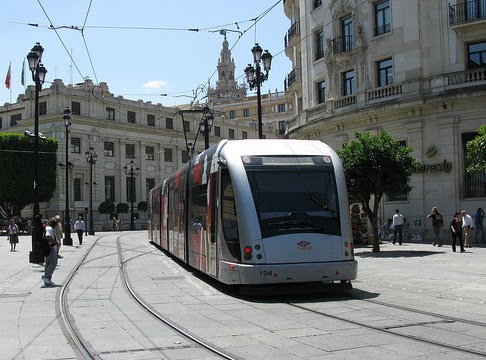
 The major sights of the  city center, about 10 minutes away by bus, are connected by a 2.7 km. pedestrian mall, through which a tram rums—very convenient for tourist with sore feet.  In our case, the first stop was a shoe store, where I became the proud owner or a good pair of walking shoes.


 The  early 20th century 'Adriática' building on Avenida de la Constitución.


Then on to the Cathedral.  The tower, La Giralda, was build as the minaret for the original mosque, but is now the bell tower of the cathedral. 


 …and the Alcázar, the palace.  I was castled-out at this point, and we didn’t take the tour.  Next time. 


Seville’s old Jewish QuarterBarrio Santa Cruz, surrounds the cathedral and palace. There was a Don Quixote, of course,


…and lots of shops and cafes. 


The menú  turistica looked pretty good, in all five languages, but it was early for comida, so we just had a beer.


The Plaza de Torros was a on the river front, a few blocks from the center.


And across the river, the Guadalquivir, is the barrio La Triana, where we had “tapas” at a what turned out to be a snack bar—frozen fast food, not recommended.


And in the evening we went to a flamenco show, 


Where we saw a group very much like this one:


We liked Seville very much…  and there was much more to see.


Leaving Seville, we took a rental car south through Jerez de la Frontera (home of sherry) to Cadiz, where once again I managed to reserve a hotel that turned out to the in the area, but not in the city.  So we spend the night in a pleasant hotel in the considerably less interesting Puerto de Santa Maria, 30 km or so away.


 Hotel Los Jandalos Santa Maria

A few doors down was a sherry bodega that sold its wines from the casks to the folks in the neighborhood and the occasional tourist.  After sampling a bit of everything we bought a 2 lt.  plastic bottle—the only size they sold—of oloroso.  I enjoyed the first few glasses.


Santa Marta, said to have been founded by an “Athenian leader in the days of the Trojan War named Menesteo,” also has a castle, the Castle of San Marcos, built over the remains of a 10th century Islamic mosque in 1364.  But touring hours were too late for us; we were on our way to Ronda.


Castle of San Marcos


From Santa Marta we went east towards Ronda through rural mountainous country, away from the main roads.


Ronda was one of the most interesting cities we visited. The old city is on a cliff-top island, separated from the modern town by an incredible chasm.


The “new” bridge, constructed from1751 to 1793, is 120 m. high.  It connects the new town, to the right, with the original city (behind the camera) built by the Romans. 


  Tourist shops in the old city near the bridge.


The view across the canyon from the old city.


The old city.


The “old bridge,” from the “Arab bridge.


Gate at the Arab Bridge


The plaza of the new city of Ronda.  We ate at one of the restaurants behind Alejandra.  See “Eating Iberian” in my food blog.


And then off on a rainy afternoon to Granada and La Alhambra.

10/14/2010

Europe, Sept, 2010 - Portugal

Europe, Sept, 2010 - Portugal

From Cáceres the night train took us to Lisbon, where we awoke a few miles east of the city along the broad estuary of the Rio Tejo.  Our hotel, the Amazonas (the H on the map), was in the Barrio Alto, a modern area a few miles north east of the historic city center, the Baixi, or lower city.   Fortunately it was half way between a subway stop and a mall, where we found a laundry and got our clothes washed.


The subway took us to the city center, now a pedestrian mall.


This was the Barrio Baixi, rebuilt after the earthquake and tsunami of 1755 which destroyed most of the lower city.  A few blocks away is the Elevador da Gloria, (below) a funicular that links downtown to the Bairro Alto district, on a cliff above.


 From the top we had a great view of the city.  On the hilltop you can see the profile of the Castelo Sãn Jorge.


And the Praça dos Restauradores, commemorating the restoration of Portuguese independence in 1640 after 60 years of Spanish rule.


 From the top, we walked down again to Praça da Figueira, the Square of the Fig Tree.  We saw the statue of King Joao I, but no fig trees.

 
But we found the trolley stop and took a trolley up the hill to the castle. 


The trolley let us out at a terrace with a great view of the eastern part of the city. 

  
Higher up, we entered the castle, originally built by the Romans in the 6th century, and modified by the Visigoths, Moors, and the Christian King Afonso Henriques who captured it in 1147.  


At the entrance is a statue of King Afonso Henriques, founder of the Portuguese nation (and presumably, Alejandra’s ancestor)


An attractive (and expensive) restaurant now occupies Afonso’s palace.


Crossing the moat to the entrance to the main portion of the castle.


The towers and walls are most of what remains.


But the view is great.  Below is the river front Terreiro do Paço or "the palace's square" where the royal palace stood before the earthquake, and in the distance is the 25th of April bridge, named after the 1974 coup that let to the end of the Portuguese dictatorship and to democracy.


Lisbon’s other historic district is Belem, port of departure for the Portuguese explorers of the age of discovery, west of the city center in the area of the bridge.  We took a trolley to visit it one evening.  Below is Jeronimos Monastery, built in 1502.  Vasco da Gama's tomb is inside.


The western wing of the monastery is now a maritime museum, unfortunately closed when we visited.


And south of the gardens, along the river front is the Discoveries Monument, built in 1960 to commemorate the 500th anniversary of the death of Henry the Navigator.


 Leaving Lisbon, we took the bus south, over the bridge, heading toward Faro.


The landscape south of Lisbon is typical Mediterranean, low hills covered with shrubs and small trees, and the occasional olive or citrus grove, or vineyard; much like parts of Southern California or Central Chile


Faro, in the far south is a favorite vacation spot for the English, with attractive beaches, abundant golf courses and resorts.  Our hotel turned out not to be in Faro as it seemed to be listed by Expedia, but some 17 km. away.  Careful reading would have prevented the error, but that didn’t help when we got off the bus.  After looking unsuccessfully for a local hotel (all expensive and full) we took a bus and then a taxi to our Hotel, the Ria Plaza Resort, in the middle of nowhere. 


Hotel, pool, restaurant, bar, tennis, golf: pleasant but not especially Portuguese. Understandably popular with British vacationers.  We lunched on club sandwiches and beer and enjoyed the rest from frenzied tourism.


 And the next afternoon returned by taxi to the bus station in Faro, and took our bus west, across the Guadiana River into Spain and on to Seville.


Next:  Andalucía